On starting too many projects
One criticism that can be made to how I usually manage my life is that I start too many projects and finish too few of them. This has two effects on my productivity:
- continuously starting new projects scatters my energy across too many directions, reducing the number of completed projects per unit of time,
- many projects require me to leave things in a half-finished state (half-mounted furniture, half-cleaned keyboard, etc), massively increasing the confusion around me
From these two objective facts, many negative feelings develop:
- half-completed projects keep triggering the thought of “never finishing things”, which ironically adds negativity to that project, making me avoid it to relieve the stress, effectively creating a negative spiral
- completing few projects erodes my confidence in my ability to move forward in life
- I get to enjoy fewer positive outcomes of projects given I complete fewer of them
I think this can be seen not only by myself, but also by my family, through the many things I’ve left half-completed around the house, or at work, through the many good ideas that never see the light of day. “Plenty of good ideas, rarely finishes one” could be a good description.
I feel this has something to do with boredom. It’s similar to what happens to me with books: I find it very hard to finish them. Sometimes it’s right after the beginning, sometimes near the end, doesn’t matter: I am captivated by the idea of starting a new one, and so I leave the current one(s) there, “for later”. Notice that I don’t think I’ll abandon them: I am just postponing it.
So, I feel an irresistible temptation to start something new. Or is it a way to escape negative feelings coming from difficulties in whatever I was already working on? Or maybe the fear of failing at them, now that I’m close to the end? Or is it ADHD? I don’t know, and I think it’s too ambitious to figure that out here. Anyway, this mechanism plays a role for sure.
Anyway, I think I could benefit from a more focused and disciplined approach. Being explicit about which goals I want to achieve first, with the consequence of postponing all actions that are not related to them, will hopefully have some impact in my daily routine. More specifically:
- achieve goals quicker, giving me back some trust in my ability to deal with the complexity of life
- reduce the amount of half-done projects I leave behind, reducing cognitive load and stress related to them
- change others’ perception of my ability to finish things I start (at least about the things I start)
That is, of course, all theoretical. I have already attempted in the past to refrain from performing activities outside a fixed set of selected ones; every time, the temptation (or pressure?) to do something else was too strong, and I got derailed.
Maybe this “temptation” isn’t something that should be fought. Maybe there is some vital energy in the desire to go “freestyle”. Or maybe this is just attention deficit developed through years of switching between rectangles on a monitor, and there’s nothing worth saving here.
Anyway, let’s see what I set up in Martin.
There used to be a page where all active projects were listed in a tree structure with their sub-projects and, at the end, their own tasks. Only active projects were present in that page, but there was no space for “pending” or “suspended” projects. Moreover, the structure of the app encouraged me to put down a lot of projects in that tree without any particular limits, with the result that it became cluttered with stale projects and tasks.
After a quick chat with Claude I introduced a concept from GTD I didn’t use that much back in the day: the “[[Definitions#Maybe|Maybe]]”. Well, I called it like that, but I believe it would be better to use a set of names like “maybe / someday”. Ok, the name is temporary, don’t get upset.
The idea behind a Maybe is that there are things I want to work on, but that I’m not focusing on right now. A Maybe cannot have tasks or sub-Maybes, enforcing the concept that they are not projects, and so any effort to analyse them and find actionable items should be postponed to when it gets promoted to a project, marking its entrance into my focus zone.
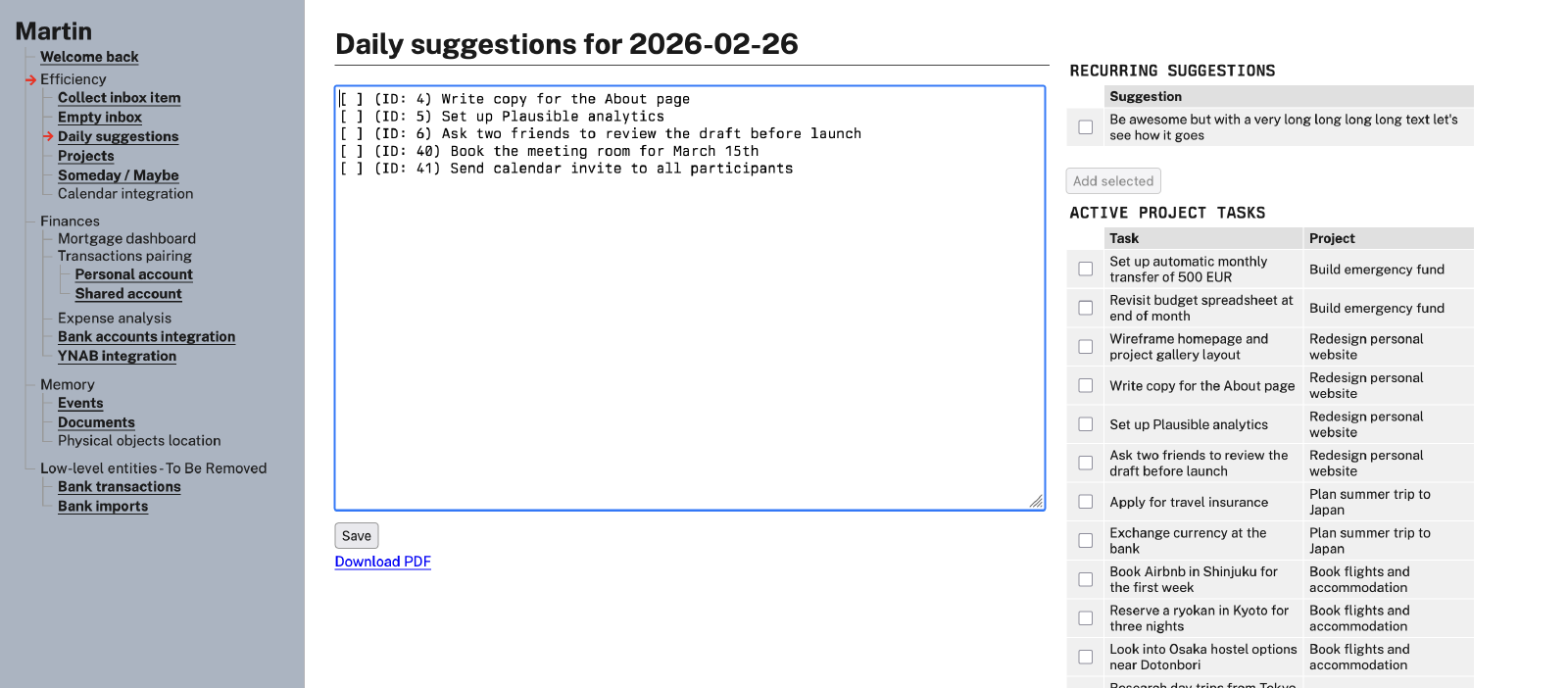
I was tempted to put a hard limit of max. 10 active projects, but I opted instead for a soft rule enforced only by me. However, I am also finally listing all actionable tasks on the Daily Suggestion editor page, with the result of being able to pick from them when I draft my suggestions for the day.
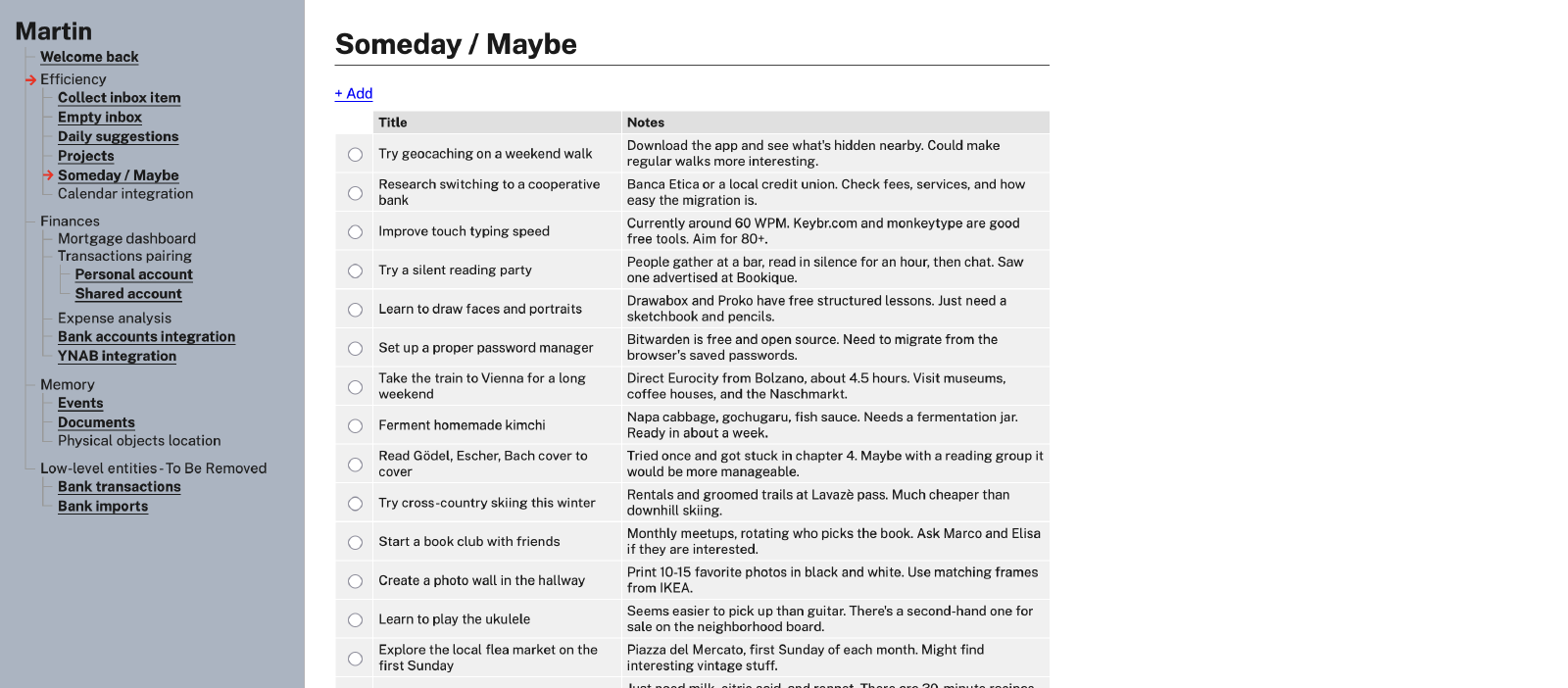
The introduction of this new concept opens the door for some inconsistencies within Martin.
- Does it still make sense to have “pending” projects?
- If I put a project on hold, where should it be listed? Should it revert to Maybe status?
- When should I review the Maybe list? Should there be a process for that? Or will they just be stacked here to be forgotten forever?
But I am fine working with an inconsistent software; from inconsistencies comes clarity.
And, first of all, I first want to confirm that this concept is actually useful. I might be adding too much process and overhead to my daily routine, and I can already feel some resistance to completing them, due to a mix of causes that I will probably investigate more in a future post.
Let’s try this out for some weeks, see if it sticks or if it proves to be helpful in any way. It might be hard for me to stick to this approach, but in the end I think I can greatly benefit from it.