Alienation and acceleration - book review
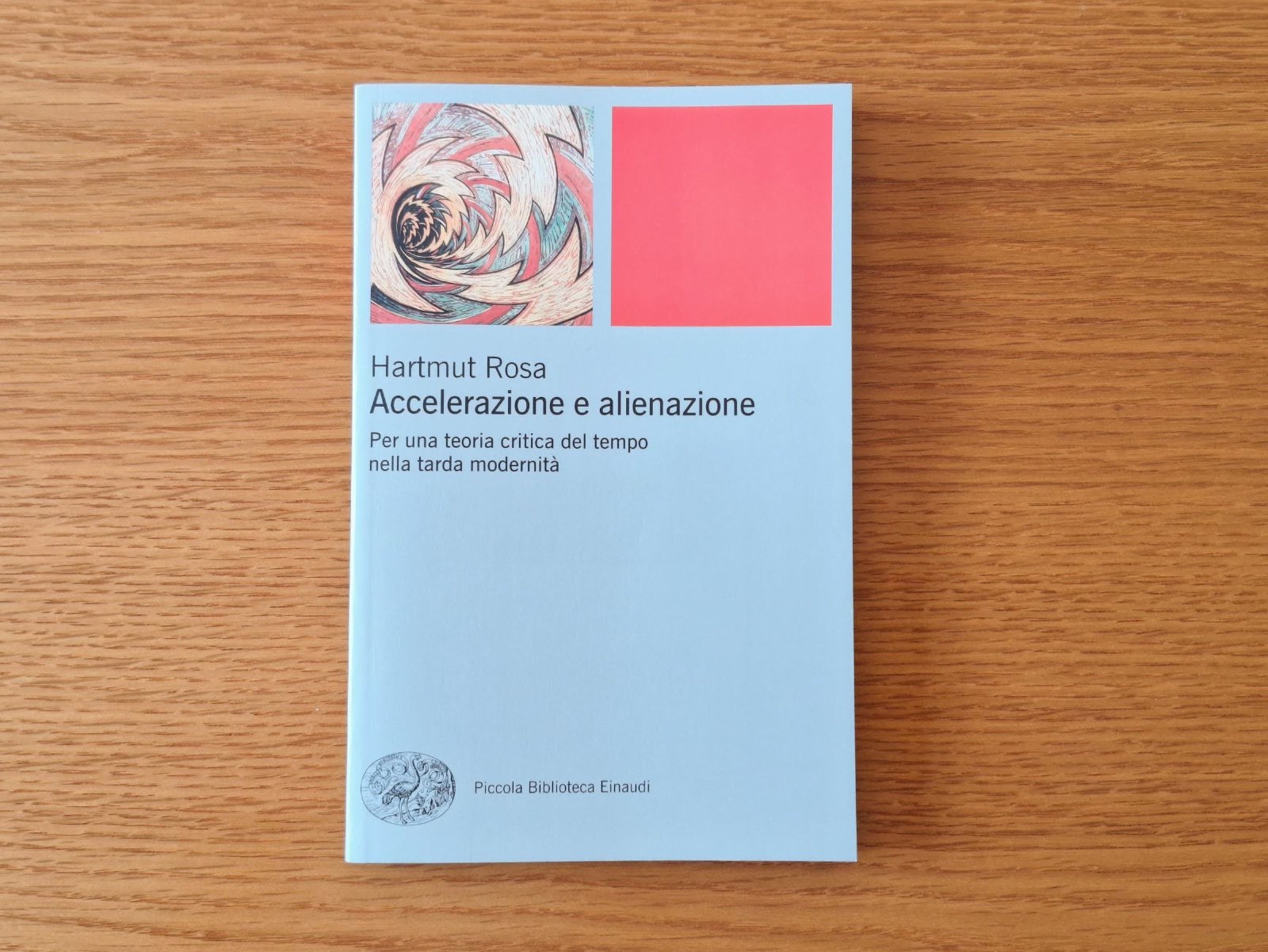
The world of time management books is vastly dominated by what I call the “USA-style” narrative. “Do these 5 things every day and your life will dramatically improve”, or “the hidden secret behind your secret weapon against…”. Books made to sell, with some scientific evidence, concrete suggestions, big claims. Even through this superficial description, I am pretty sure everyone interested in the topic knows what I mean.
Among the common traits these books share is that they propose an individualistic point of view of the problem. Everything is under the control of the individual. The problem, whatever root it has, is treated with changes in daily lifestyle. The widest groups of people they might focus upon are support groups, which serve the sole scope of sharing experiences about your individualities.
This reflects also in their peculiar way to describe history. While some sense of context evolution through time exists, it often goes from prehistoric times to modern times. Both for technology and processes, it seems a whole portion of history is neglected, which is exactly the part that should have required these books to talk more about society and the way human beings organize themselves. There are some noticeable exceptions, but for most of these books the reasoning goes like “our brain is still wired like when we were little more than apes, so it cannot handle modern exposure to inputs and information”. This mental model is easy to grasp and brings valuable information, but it completely omits any discussion about society.
This is not wrong per se. This kind of book owes part of its success to the fact that individual action is the only action that works in the short term. There is also a big portion of marketing and flamboyant promises that drives their success, no doubt about that, but they offer small actionable steps into improving your life, which is usually exactly what the reader wants. You can start, today, without obstacles, to be more organized, productive, happy; isn’t this the reason you were reading the book?
But even if these books “work”, they leave us with a partial view of our context. There’s a limit to what an individual can do when rules, laws, trends and traditions have been built into a social tissue. Their goal is to find something you can work on, and so they omit discussing the topic of time in a broader way, avoiding talking about the things the single person cannot change, which often are the big parts.
Alienation and Acceleration by Hartmut Rosa is different. It has no goal of providing the reader with a set of practices to improve his/her life; its goal is instead to analyse, down to the root causes, the incremental speed at which we live our lives and the side effects of living this way. By doing so, it puts the focus back on society, bringing some fresh air into a world that was dominated for too long by a single — and very partial — point of view.
The book is concise, direct, intuitive, sometimes perhaps too academic, but its contribution is refreshing and useful. It doesn’t bring the reader new practices to fight lack of time, but I’d argue it does something even more powerful — not because it’s intrinsically more important, but because we’ve lacked it for so many years: it removes pressure from the individual.
Because if the confusion, the FOMO, the constant pressure and lack of time is not because of what you, as a person, do or don’t do, but comes from something bigger than you, over which you have limited power… then the feeling of responsibility also drops a little. It is not because you haven’t structured your TODOs lists, or because you didn’t do your weekly review, that you feel this way. And whatever you’ll do, the external pressure to make you feel like that will continue to exist.
That point of view in the debate about personal time and work-life balance has been very much needed in the last year, at least from my point of view. And while the book focuses more on alienation than on this lack of time, I think its contribution about it is worth talking about.
A couple of points that stuck with me, in no particular order.
Instability of social relationships
The book shows how the overall speed at which we’re living our lives is increasing, making the bonds that shape them weaker and too unstable for us to identify ourselves with them. In recent years we’ve moved from social relations that spanned multiple generations to ones that will change multiple times even within a single generation.
A couple of examples from the book:
- Once upon a time, the son inherited his father’s job; then, for a couple of generations, everyone was prompted to find his own job, which defined him/her as a professional and lasted a whole life; now, people can change the kind of job they do multiple times within their own life. This resonates with me: my wife has changed profession at least three times so far.
- Once upon a time, it was not uncommon for homes to house the entire family unit and to be kept within the family for a couple of generations. Or, at least it was normal to stay within the same city or village as your parents; then, for a couple of generations, a new married couple bought their house once married, and lived there for their whole life. The house was identifiable with the family living in it. Now, it is very common to change house at least a couple times during life, and maybe in totally different cities/countries. Again, this resonates with me: now, in my area of Italy, a family stays in a house for only 15 years on average, so a person will live in several houses within their life.
- But “a family” itself is hard to use as a measure for the reasoning above, since the increasing number of divorces shows that people will form more than one family nucleus during their life. This resonates with me: my new neighbor has built two families and he’s still young.
There is an evident trend towards making everything change more quickly. But the speed at which we re-shape our relationships with other people, places, or with the tools we use, risks worsening our experience of them: when the world changes faster than we can experientially make it our own, we end up feeling estranged from space, time, things, our own actions, and even from ourselves. Hence, the sense of alienation brought by speed, as described by the author.
Broken promises
The combination of increased access to new opportunities and competition as the core of our way of living has not improved our lives, as we had hoped.
The promise that, even within a competitive economy, technological progress would reduce the time needed to complete our work and our private chores, allowing us to work less and dedicate ourselves to “higher” activities compared to those of our daily routine, has turned out to be false. Six hours of work a day, or four working days a week, were seen not as a goal to be reached, but as an inevitable shore towards which the tide of progress was carrying us; now we talk about 9-9-6, meaning “at work from nine in the morning to nine at night, six days a week”.
Today, that promise has clearly been broken — in fact, we have moved in the opposite direction. The instability of working relationships forces us into a perpetual search for competitiveness, often at the expense of our personal time. There are many things to study, too many, and they increase every day with greater intensity; I say this as a developer trying to keep up with the innovations in the AI world, sacrificing part of my time in an effort not to fall behind — behind contemporary standards, at least, which nevertheless feel increasingly inhuman.
Even the world of personal productivity has moved from a first generation, whose underlying message was “organize yourself properly and you’ll manage to cope with this chaos”, to a second generation, born out of criticism of the first, where the message is instead “you will never manage to cope with this tide of activities, let’s try to manage the damage”. A clash between a David Allen, where everything was manageable through the optimistic message of GTD, and a Cal Newport, where one finds ways to work less (but better) and become a “better procrastinator”.
A comparison with religion
And what remains is the rush and a systemic sense of guilt, in which the individuals are placed in front of a workload they will never manage to complete, but for which they nevertheless feel guilty because they feel they have not kept up with expectations, they have not been competitive with their peers, and that they will therefore be left “behind”.
Personally, I feel this sense of guilt strongly; many of the things I do revolve around it. In the book, the author draws a comparison — relevant, to me — between this feeling and the studies that have been done on the sense of guilt of deeply religious people. There are analogies, but one interesting difference is that religions also offer ways to atone for this guilt. We are born sinners, we are constantly faced with temptations to which we constantly yield, and yet we are able to free ourselves from this inner burden through confession. Rituals and practices for removing this sense of guilt that is imposed on us come with the package, and turn out to be very effective — not zero-sum, but rather offering a constant sense of relief.
Conclusions
I think this new lens to look at the issue of lacking personal time, which is dear to me, opens new questions and opportunities to develop the themes further. The author has already evolved his theory in Resonanz, where he advocates for embracing speed but only for things that increase our sense of “resonance” with the world, instead of alienating us from it.
But the reasoning about guilt, the similitude with religion, and the fact that this book — just by existing — made me feel a little better, makes me wonder if a big portion of “why” people get into the productivity world right now is just to deal with guilt.
I wonder whether the contemporary world of productivity isn’t, at least for some people, more a way to ease the sense of guilt imposed by a society with ever-higher expectations, rather than aimed at achieving our goals.
So, maybe, are TODO lists our prayers? Are weekly reviews our confessions? Sure, maybe we’re more productive, but are the productivity systems we adopt actually the ones that best silence that little voice in our head that keeps pushing us to do more, threatening disaster if we stop for a moment? Was David Allen just looking for a way to be at peace with himself?
Anyway, I guess I’ll have to read the rest of his books to find more about it, but I don’t know if I’ll ever have the time.